
Covid-19 Protection Village Level, India


www.economicswithsnig1.blogspot.com
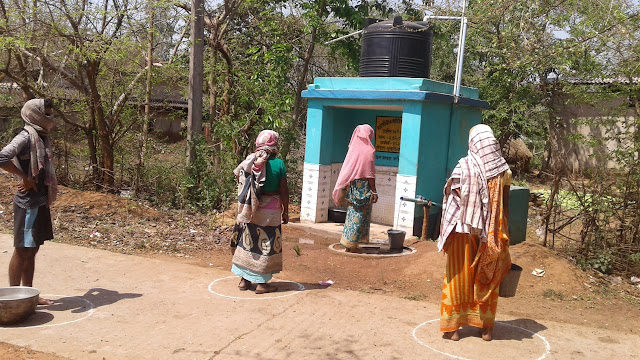
Maintain Social distancing in Village level


Today I am telling you some of the silent workers who help us to overcome the situation of Covid-19 during the lockdown situation in village level. During the last few years I was associated with a civil society organization of development work. During the time I used to go various remote villages in the Jharkhand region to enhance their livelihood and develop structures of institution through various programs. Here structures and organization means community based organization like Self help groups, Village organization etc. Those who are in corporate sector hardly know about these, but in the current situation these structures play a vital role throughout the country. In these community based organization (CBOs) leading role have been played by the village women. Most of the members are illiterate but the unity and activeness to do something is surprised you. On the one hand they do their daily household work on the other hand they handle their kids, earning some amounts to work as a labor and attend these CBOs to get more opportunities in livelihood and somehow secure their futures by getting loans and save a small amount of money in their self help groups . Villages are the back bone of every industrial cum agriculture based countries and now these tribal women villagers take big responsibilities towards development of the country.

In economics we read various types of theory but practically we see that the uses of these theories are limited in our copies and survey sheets. The outcome of the research take a nice look of articles but the benefits of the outcome merely comes towards the grassroots levels .In these contest I would like to say that civil society organization and NGOs immensely work with these community levels and regularly develops various strategies to assemble these structures. In these lines I want to bold that if these organizations (CBOs) get more support from us, then there must be a flashing scenario develops.


During the Covid -19 pandemic breakdowns, when most of the world compels to stay at home, at this time these CBOs built a wonderful example as an Indians. All we know that In India we have 130 crore populations and when we heard the news of broke out of these pandemic in the western countries then most of the experts worried about to imagine  the broke out of this pandemic in India due to huge population and limited availability of infrastructures. Our central and state Governments, Doctors, nurses, police, and administration set brilliant examples to handle this situation. In the meantime this CBO structures which does not come into the flash light but worked silently. 

Making Masks in Village


In the village level SHG members made masks and distributed among the villagers, maintaining social distance and aware their natives about the covid-19.Moreover they support the distress peoples by contributing food from their limited resources. They distributed foods from village organizations (V.O) funds and set example of, “where there is wish there is way”. The unity which tells us to do something is really addressable and more focus needed to cheer up this affords.

Kitchen Didi Program


Most of the state Governments with the help of these structures reaches among the remote villages. Mukhya mantra didi kitchen is one of the examples of that. Active V.O members take the responsibilities to make the food and served among the distress, workless labors and who have not food. V.O members provide the services throughout the panchayet within a block. Day and night services which lend a hand to feed a number of hunger people of these villages really remarkable. They also aware the common protectiveness such as wash hands, use masks and maintain social distancing to overcome the situation of Covid -19 .I Salute their relentless effort which protect us from starvation and help to step up one stair to win the war from Covid-19.


Comments

Popular posts from this blog

Land reform in India

Land Reform                     India is an agrarian country. A large part of income comes from the agriculture sector. Though the agrarian structure was not so good in India and considers the main obstacle to economic development. The main hindrance which was considering the impediment of agriculture sector is …….. 1) existence of intermediaries between the state and the cultivators.2) tenants are very much insecure here, due to huge pressure of debt, absence of ownership rights, minimum   subsistence level output remain in their hand.. 3) Small and fragmented land hindering to implement of techniques for better production. 4) Uneven distribution of land holding create miserably huge difference    between upper and lower section of the society.5) foremost lack of effective organization of the peasantry. Objectives of land reforms The main objectives of land reform are to growth oriented of agriculture ...

Zamindari,Ryotwari, Mahalwari system In India

A t the time of independence there were three types of land tenure prevailing in India. They were the Zamindari system, the Ryotwari system and the Mahalwari system. The basic difference between these systems was made of payment of land revenue. But in this three systems the usual practice was, land cultivated by the tenants. Tenants themselves were three types 1 ) Occupancy tenants ---- enjoyed permanent and heritable rights on land, eligible to claim compensation from the land lord. 2) Sub tenants ----- appointed by the occupancy tenants. They did not have any security as tenure. 3) Tenant at will ---- appointed by the land lord and did not have security as a tenure could be evicted from the land at any time. Now we discuss the three main intermediaries system of land one by one. Zamindari system    ---- This system was started during the British period in India. The pioneer of this system was Lord Cornwallis. This system came in...

REVERSE CHARGE MECHANISM (RCM)

After the implementation of GST there are lots of confusions arises among the common people, traders, business man and manufacturer about the taxation system, the main confusion surrounded between the two taxation terms that is input tax credit and reverse charge mechanism (RCM). As our GST rule all we know in a business, if the annual turnover in a financial year is within Rs 20 lakh (Rs10 lakh for north eastern and hill states) then he have not required paying GST. But the confusion arises when the rule is going to the market. From the earlier discussion  How GST works it was shown that the whole GST process is actually a chain system. That means if manufacturer pay GST when he buy inputs and wholesaler buy the finished product with the proper GSTN(GST registration number),then wholesaler are eligible to claim input tax credit from the government. The Indian industrial sector are divided two parts organized sector and unorganized sector. Many big industrial secto...